Basic Knowledge of Islam for Beginners to Learn
Islam is the world’s second-largest religion, with approximately 2 billion followers. It is not just a set of rituals practiced once a week. It shapes how a Muslim prays, eats, speaks, and lives every single day. Basic knowledge of Islam for beginners covers one God, five pillars, and a complete way of life rooted in peace, purpose, and submission to Allah.
The Prophet Muhammad (peace be upon him) said: “Seeking knowledge is an obligation upon every Muslim.” (Ibn Majah). Whether you are curious or just starting out, the real question is this: where does a beginner actually begin?
What Is Islam
Islam is a religion that believes in one God. That God is called Allah in Arabic. Muslims believe Allah created everything. He has no son, no partner, and no equal.
The word Islam comes from the Arabic word salam. It means peace. It also means submission. A Muslim is someone who lives in peace by submitting to the will of Allah.
Islam is not just about going to the mosque. It covers every part of daily life. How you eat, sleep, talk, and treat people all matter in Islam. It is a full way of living, not just a weekend routine.
The Six Core Beliefs Every Muslim Must Know
Every Muslim holds six core beliefs in their heart. These are called the Six Articles of Faith. They are the starting point for anyone learning about Islam. These six beliefs shape how a Muslim sees life, death, and everything in between:
- Belief in Allah: One God, no partners, no equals
- Belief in Angels: Created from light, they carry out Allah’s commands
- Belief in the Holy Books: The Quran, Torah, Psalms (zabur), and Gospel (injeel)were all from Allah
- Belief in the Prophets: From Adam to Muhammad (peace be upon them all)
- Belief in the Day of Judgment: Every person will answer for what they did
- Belief in Divine Decree (Qadar): Everything happens within Allah’s knowledge and will
Without these six beliefs, the five pillars have no real meaning. Belief always comes before action in Islam.
The Five Pillars of Islam
The Five Pillars of Islam are the main acts of worship that form the foundation of Muslim life. Each pillar has its own conditions and rules.
Shahada
Shahada means the declaration of faith. It is the first pillar of Islam. A Muslim says: “There is no god but Allah, and Muhammad is His messenger.”
Saying this with full belief makes a person a Muslim. Everything else in Islam builds on top of this one statement.
Salah
Salah means daily prayer. Muslims pray five times every day. The five prayers are Fajr at dawn, Dhuhr at midday, Asr in the afternoon, Maghrib at sunset, and Isha at night.
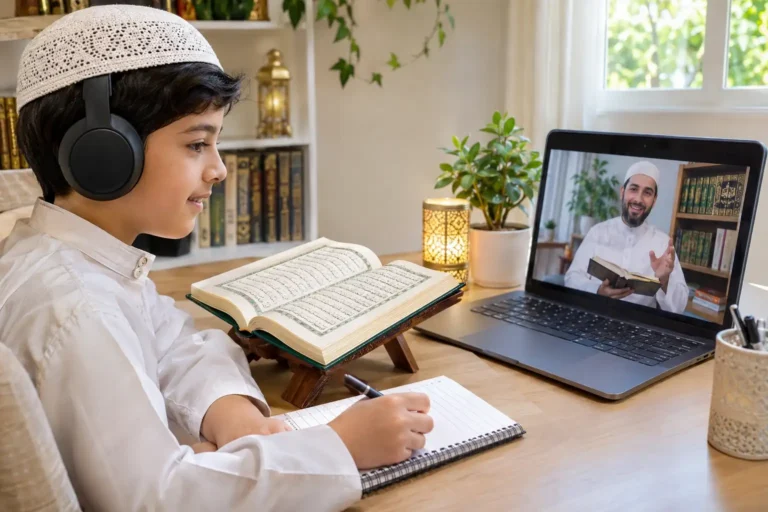
Prayer keeps a Muslim close to Allah throughout the whole day. It is a direct connection between a person and God. Young learners can start building this habit early through the Basic Islam For Kids course, which teaches the steps of prayer in a clear and simple way.
Zakat
Zakat is obligatory charity. Eligible Muslims generally pay 2.5% of their qualifying wealth when it reaches the nisab and meets the required conditions, including the lunar-year requirement.
Zakat teaches that money comes from Allah. Sharing a part of it is an act of worship, not just an act of kindness.
Sawm
Sawm means fasting. Every year, Muslims fast for the entire month of Ramadan. From dawn to sunset, they do not eat or drink anything.
Fasting teaches patience. It builds self-control. It also creates real empathy for people who go without food regularly.
Hajj
Hajj is the pilgrimage to Mecca in Saudi Arabia. Every Muslim who is able, physically and financially, must perform it at least once in their life.
Millions of Muslims have performed Hajj over the years.According to Saudi Arabia’s General Authority for Statistics (GASTAT), a total of 1,707,301 pilgrims performed Hajj in 2026 (1447 AH). Everyone wears the same simple white cloth. No one looks richer or more important than anyone else. Hajj shows that all Muslims stand equal before Allah.
The Quran and Its Importance in Islam
The Quran is the holy book of Islam. Muslims believe it is the direct word of Allah. It was revealed to Prophet Muhammad (peace be upon him) through the angel Jibreel over a period of 23 years.
The Quran has 114 chapters called Surahs. They cover prayer, family, justice, kindness, and how to live a good life. The Quran was revealed in Arabic and has stayed in its original form to this day. Not a single word has changed.
Many beginners start by learning the short Surahs already recited in daily prayer. Understanding their meaning makes prayer feel like a real conversation with Allah. The Learn Quran Translation course helps beginners understand the meaning verse by verse. For those who want to go deeper, the Online Tafseer Course explains the full context and wisdom behind each chapter.
Prophets in Islam and Their Role
Allah sent prophets to guide people throughout history. Islam honors all of them. Adam, Noah, Abraham, Moses, and Jesus (peace be upon them all) are recognized and deeply respected in Islam.
No prophet is worshipped. Worship belongs to Allah alone. Prophets were human beings chosen to carry a message from God to people.
Prophet Muhammad (peace be upon him) is the final prophet. No messenger comes after him. His sayings and actions are recorded in the Hadith. Muslims follow his example, called the Sunnah, as a practical guide for everyday life.
Daily Life and Basic Practices of a Muslim
Islam touches small, everyday moments. Simple habits done with the right intention become acts of worship. Here are the key daily practices every beginner should know.
Halal and Haram refer to what is allowed and what is forbidden in Islam. Halal means permitted. Haram means forbidden. Pork and alcohol are well-known examples of haram food and drink.
Dhikr means remembering Allah through short phrases during the day. Alhamdulillah means all praise is for Allah. SubhanAllah means glory be to Allah. These small phrases keep the heart connected to God throughout the day.
The Islamic Greeting is As-Salamu Alaykum, which means peace be upon you. Muslims say this to greet one another. It is both a greeting and a prayer for the other person at the same time.
Modesty in Islam means behaving with decency in how a person dresses, speaks, and acts. This applies to both men and women equally.
How to Start Learning Islam as a Beginner
Starting feels big. But it does not have to be. The key is to take one small step at a time and build from there.
Start with the Shahada. Understand what it means, not just how to say it. Then move on to learning the five daily prayers step by step. Use beginner-friendly materials and go at a pace that feels comfortable.
For children, the Basic Islam For Kids course makes Islamic learning simple and age-appropriate from a young age. For anyone who wants to connect with the Quran directly, the Learn Quranic Arabic Online course builds that skill one step at a time.
Ten focused minutes every day leads to real knowledge over time. Consistency is what matters most, not speed.