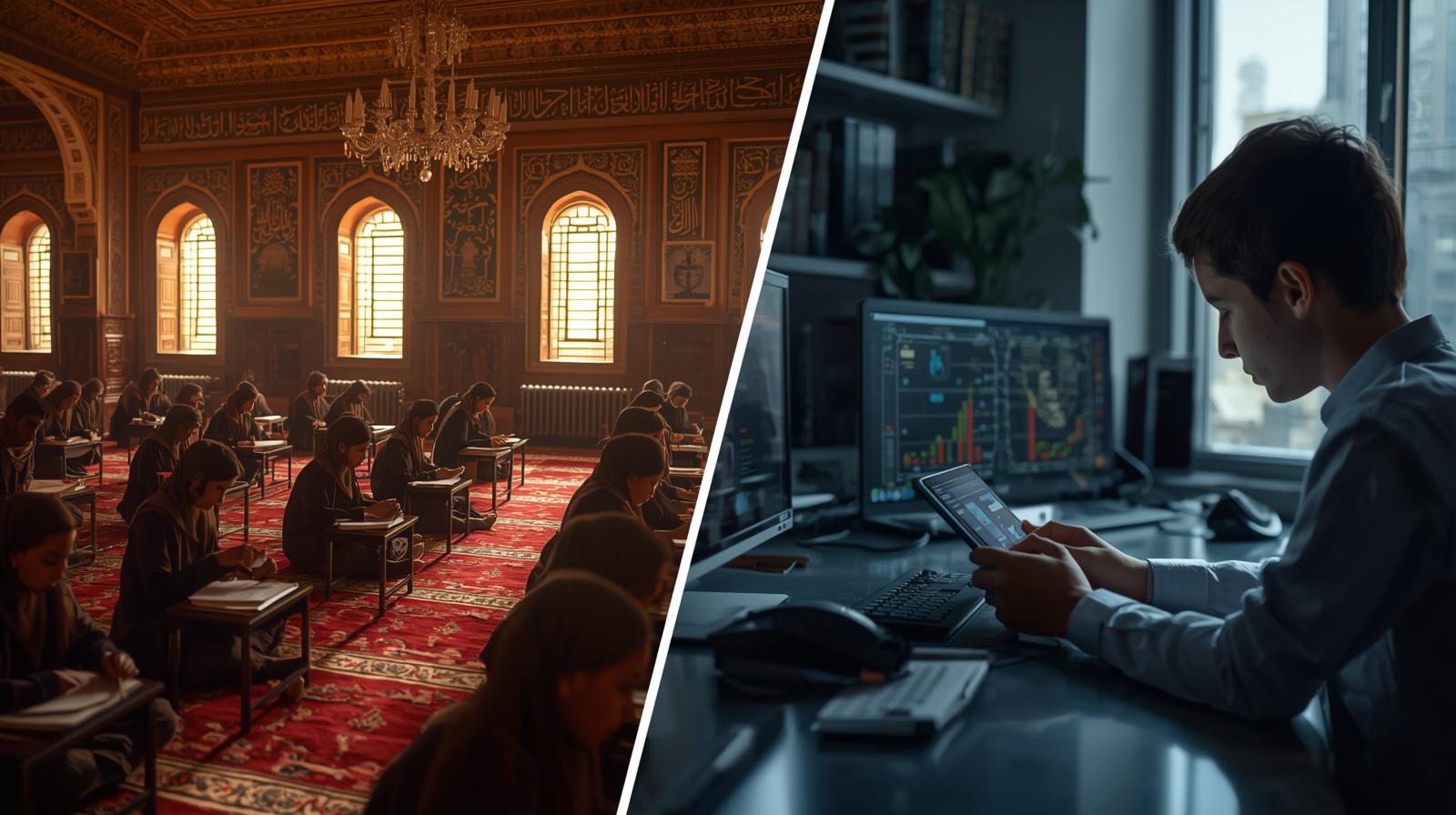
Hifz Online vs Madrassa: Which Should You Choose?
Over 300 million children worldwide are currently memorizing the Quran. That number keeps growing every single year. Online hifz classes vs madrassa, online learning offers flexibility and personalized attention, while madrassa brings structure and community.
But choosing blindly without understanding the real differences can slow a child’s entire hifz journey. What actually separates these two paths, and which one produces stronger huffaz in the long run?
What Traditional Madrassa Actually Offers
Madrassas carry centuries of proven history behind them. Children recite aloud, listen to peers, and absorb a space built entirely around Islamic learning. That environment creates natural focus.
Teachers often hold deep scholarly backgrounds with unbroken chains of Quranic transmission. However, fixed schedules, transportation, and limited availability make access genuinely difficult for many families today.
How Online Hifz Classes Changed Everything
Online hifz classes vs madrassa debates used to heavily favor traditional settings. Not anymore. Live one-on-one sessions now offer real-time Tajweed correction, flexible scheduling, and undivided teacher attention.
A madrassa teacher managing thirty students physically cannot match that. Families who want their children to Learn Quran with Tajweed now find online platforms genuinely reliable and structured.
The Learning Environment Debate
Madrassa creates peer accountability and healthy competition. Many children genuinely feed off that group energy, and honestly, it shows in their progress. Online learning suits children who struggle to concentrate when there is too much noise around them.
Moving at a comfortable pace keeps both fast and slow learners motivated without unnecessary pressure. Parents still need to stay in the picture, though, a child left alone with a screen will almost always find something more interesting to watch.
Quick Comparison
| Factor | Online Hifz Classes | Madrassa |
| Schedule | Flexible, fits any routine | Fixed, less adjustable |
| Teacher Attention | One-on-one, focused | Shared among many students |
| Location | Anywhere with internet | Requires physical presence |
| Peer Interaction | Limited | Strong group environment |
| Cost | Generally affordable with flexible plans | Varies; some require a full-time commitment |
| Foundation Building | Structured, step-by-step | Often rushes into memorization |
| Parental Involvement | Higher involvement needed | Lower, the teacher manages most |
| Accessibility | Available globally | Limited by geography |
Building the Right Foundation Before Hifz
Many families rush into hifz before children are truly ready. That mistake creates frustration later. Children who first Learn Noorani Qaida enter hifz with stronger pronunciation accuracy.
Online programs that sequence Qaida, Tajweed, then hifz properly tend to produce faster memorization results. Skipping foundational steps causes errors that are genuinely hard to correct later.
Cost and Accessibility: The Honest Reality
Madrassa fees vary widely across different regions and countries. Some full-time programs require children to leave regular school entirely. Online hifz programs generally offer monthly plans, trial sessions, and adjustable schedules.
For families in small towns across Australia, Canada, or Europe, online hifz classes vs madrassa isn’t really a debate. Online learning is the only realistic option available.
Beyond Memorization: Raising Complete Muslim Children
Hifz is a beautiful milestone, but Islamic upbringing involves much more. Character, values, and basic religious knowledge matter equally alongside memorization. Platforms integrating Basic Islam for Kids alongside hifz preparation offer something genuinely holistic.
Traditional madrassas often focus narrowly on memorization output alone. Children who understand what they memorize connect with the Quran far more deeply and meaningfully.
Which Option Actually Produces Better Results?
The honest answer depends entirely on the child, teacher quality, and family situation. A strong madrassa with an excellent teacher remains a wonderful choice. However, that combination simply isn’t available everywhere.
Visit Knowledge Quran and experience the difference before making any final decision.
So, Which One Really Wins?
Neither option wins universally for every single family. Online hifz classes vs madrassa is no longer a debate where madrassa automatically comes out ahead. Online hifz, done right, reaches families that the traditional system genuinely cannot serve.
FAQs
Can a child complete full hifz online?
Yes, many students have completed full memorization through consistent online sessions with qualified teachers.
At what age is best for starting Hifz?
Ages five to ten work best, as memory retention is naturally strongest during those early years.
How do online teachers check Tajweed without being physically present?
Live video sessions allow teachers to hear every recitation clearly and correct mistakes immediately in real time.
Is online hifz recognized by Islamic scholars?
Many scholars accept it, provided the teacher is qualified and proper ijazah standards are maintained throughout.
What is the biggest challenge with online hifz?
Staying consistent and keeping the home environment distraction-free remains the most common struggle for families.
Can a child attend a madrassa and take online classes together?
Absolutely, many families use online sessions to reinforce madrassa lessons or cover any missed revision effectively.