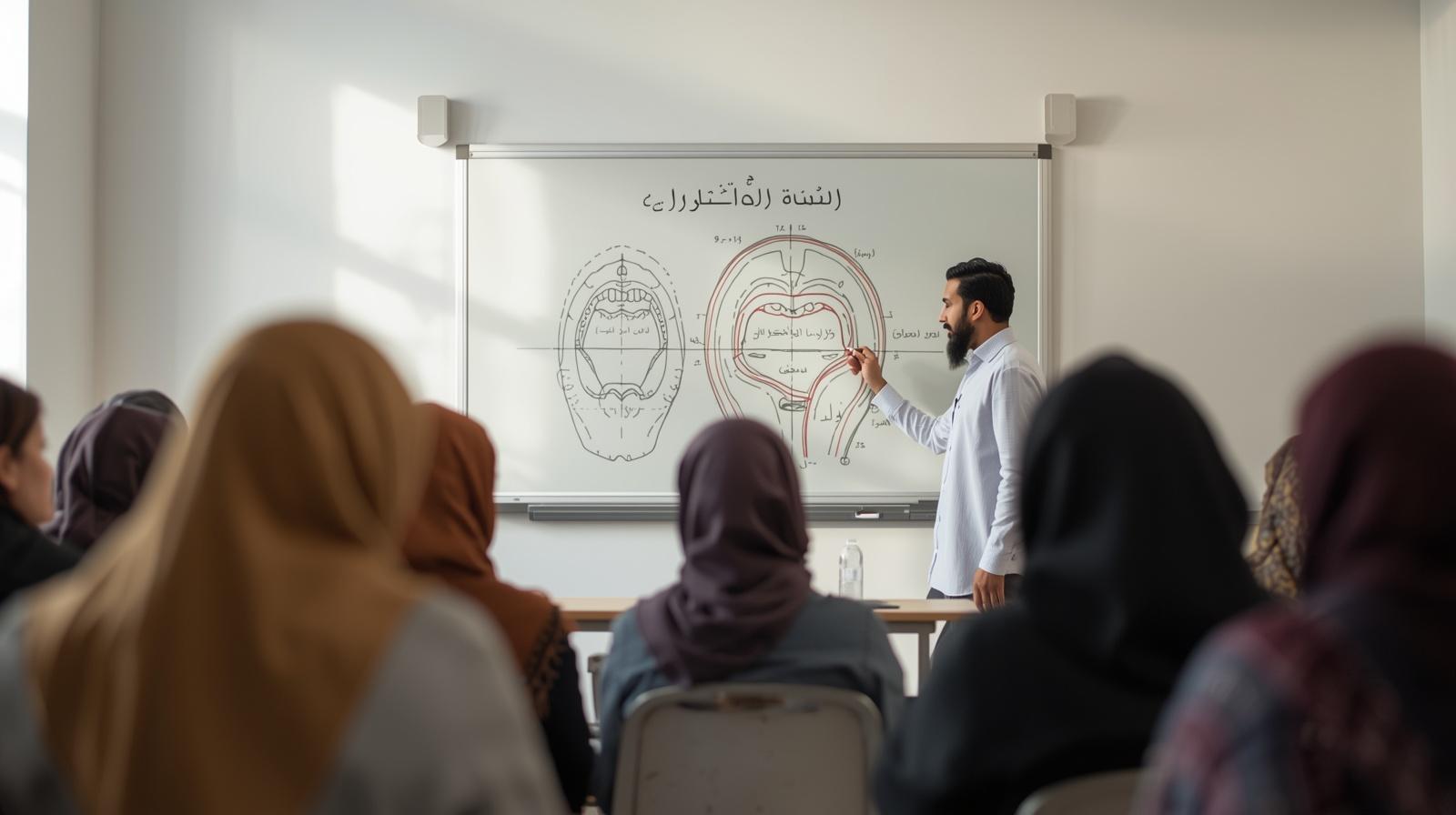
Understanding Makhraj in Tajweed Rules Easily
Reciting the Quran is not just reading Arabic text; it is a disciplined act of sound, precision, and spiritual accountability. Before mastering any Tajweed rule, one concept must land first: Makhraj.
What is Makhraj in Tajweed?
Makhraj (مَخْرَج), plural Makharij, is the point of exit, the specific location within the vocal tract, either in the mouth or throat, from which each Arabic letter naturally originates and is emitted. The full term Makhraj Al Huruf (مخرج الحروف) maps every letter to its defined origin point. Linguistically, the word signals emergence; in terminological Tajweed usage, it names the fixed position that distinguishes one harf from another. Scholars have categorized the 28 Arabic letters into 17 distinct points, grouped under five major articulation regions of the vocal tract.
A harf is not simply text, it is a sound produced by relying on a Makhraj, whether precisely defined (Makhraj Mohaqaq, covering 28 letters of the alphabet) or open (Makhraj Moqadar), where sound exits the oral cavity freely without anchoring at any specific point, like the alif. The linguistic sense of “harf” is tip, the sharpest, most directed unit of sound.
The Importance of Makhraj in Tajweed
Makharij maintain the purity of Quran pronunciation exactly as it was revealed to Prophet Muhammad (peace be upon him). The Quran was transmitted orally before being written, and the companions recited with meticulous care, maintaining every Makhraj as an act of Sunnah. One mispronounced letter can change the entire meaning, طين (mud) versus تين (fig) differ only by their first letter. Learning Makharij guards against unintended errors, deepens access to Quran vocabulary and meanings, strengthens spiritual commitment, and gives every non-native Arabic speaker a clear pathway to perfect recitation of sounds that exist nowhere in other languages.
The 5 Main Makhraj in Tajweed
Al-Halq, Where Depth Becomes Sound
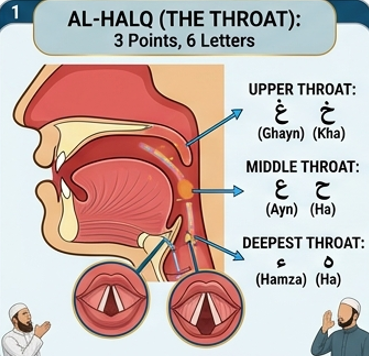
Al-Halq (the throat) produces six letters across 3 points: the deepest throat gives hamza (ء) and ha (ه), the middle throat releases ayn (ع) and ha (ح), and the upper throat articulates ghayn (غ) and kha (خ). These demand real muscle control; English rarely uses throat-based sounds, making this the steepest curve for most learners.
Al-Lisan, The Ultimate Controller
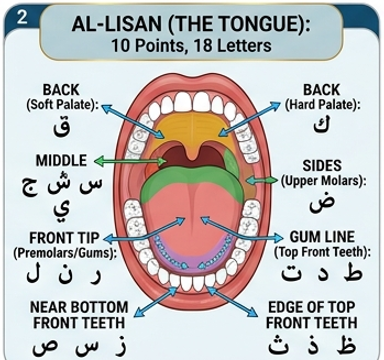
The tongue is the ultimate controller of Arabic letters, responsible for 18 letters across 10 makharij. The back produces qaf (ق) at the soft palate and kaf (ك) at the hard palate. The middle handles jeem (ج), sheen (ش), ya (ي). The sides articulate dad (ض) against the upper molars, using the left, right, or both. The front tip carries lam (ل) along the premolar gums, then nun (ن), ra (ر), and the cluster ta (ت), dal (د), ta (ط) at the gumline of the top front two teeth. Letters sad (ص), seen (س), za (ز) sit near the bottom front two teeth with a deliberate gap, not firm contact. Tha (ث), dhal (ذ), za (ظ) rest at the edge of the top front two teeth. The tongue’s flexibility accounts for the largest number of articulations in Arabic.
Ash-Shafatayn, Four Letters, Two Lips
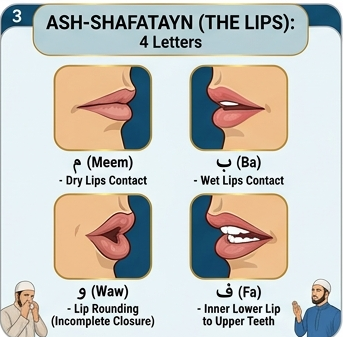
Ash-Shafatayn governs 4 letters: meem (م) from the dry outer parts of both lips touching; ba (ب) from the wet inner side; waw (و) by rounding both lips without fully closing the mouth; fa (ف) from the inner lower lip against the upper jaw teeth. Mastering lip movement is easy to underestimate, and absolutely crucial.
Al-Khayshoom, The Sound That Lives in the Nose
Al-Khayshoom (the nasal passage) is where ghunnah (غُنَّة) lives, a resonating nasalisation that sends vibration into the nose when noon (ن) and meem (م) appear under specific Tajweed rules, including noon sakinah, tanween, meem sakinah, and shaddah (emphasis). Its duration spans two counts, and its length varies by the rule applied. The nose is an integral part of articulation, and its impact on the flow of reciting becomes obvious once ghunnah is practiced properly.
Al-Jawf, Sound Born From Empty Space
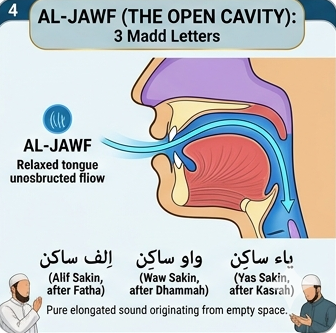
Al-Jawf is the space of the mouth and throat where the tongue rests relaxed at the bottom, and air flows out freely, obstructed at no specific point. The three madd letters, Alif Sakin (after fatha), Waw sakin (after dhammah), and Yaa sakin (after kasrah), all emerge here as pure elongated sounds from the oral open region.
Difference Between Makhraj, Tajweed, and Sifaat
Three Terms, Three Dimensions of Recitation
Makhraj (مَخْرَج) answers where the physical point of articulation for every Arabic letter is, especially critical for non-native speakers without an Arabic mother language. Tajweed (تَجْوِيد) answers how, the science of reciting the Quran correctly through proper pronunciation, rules, and rhythm, covering Madd (elongation), Idgham, and Qalqalah. Sifaat (صِفَات) answers quality , the characteristics and nature of each letter’s sound, such as Seen (س) carrying whispering (Hams) and Dhad (ض) carrying heaviness (Isti’laa). These three dimensions together form a complete recitation framework.
Conclusion
Makhraj is the foundation every reciter builds on. Across 17 points and five major regions, the resonant depth of Al-Halq, the space of Al-Jawf, the flexibility of Al-Lisan, the nasalisation of Al-Khayshoom, and the precise contact of Ash-Shafatayn, every Arabic letter has a defined, specific origin that keeps the Holy Quran as pure, clear, and divine as it was first revealed.