Lahn Jali and Lahn Khafi- An Essential Tajweed Guide
Lahn is any mistake in reciting the Quran, and it splits into two kinds: Lahn Jali, obvious errors that change meaning, and Lahn Khafi, subtle slips that only affect recitation quality.
One is treated seriously in fiqh. The other gets corrected quietly, without much fuss. Here’s how scholars actually draw that line, with real examples.
Learning the rules and principles of Tajweed ensures that every word is pronounced correctly, exactly as it was revealed, preserving its true meaning and reflecting our deep respect for Allah’s words.
What Does Lahn Mean?
The word comes from an Arabic root meaning deviation, straying from what’s correct. In everyday Arabic it can even mean melody or dialect, but in Tajweed it means one thing only: a mistake in pronunciation.
Lahn in tajweed covers anything from a swapped letter to a stretched vowel. Not every mistake is equal, though, and that’s exactly why scholars split it into two categories.
Lahn Jali, The Apparent Mistakes
Lahn Jali is the kind everyone notices, expert or not. It touches the letters, the vowel markings, or the words themselves, and it can flip a verse’s entire meaning.
Take “أَنْعَمْتَ” in Surah Al-Fatiha. Swap the final fatḥah for a ḍammah and “You (Allah) have bestowed” quietly becomes “I have bestowed.” One vowel, and the subject of the sentence changes. That’s the danger with Lahn Jali examples like this, they’re small on the page but massive in meaning.
Examples of Lahn Jali (Major Mistakes)
Common examples of Lahn Jali are as follows:
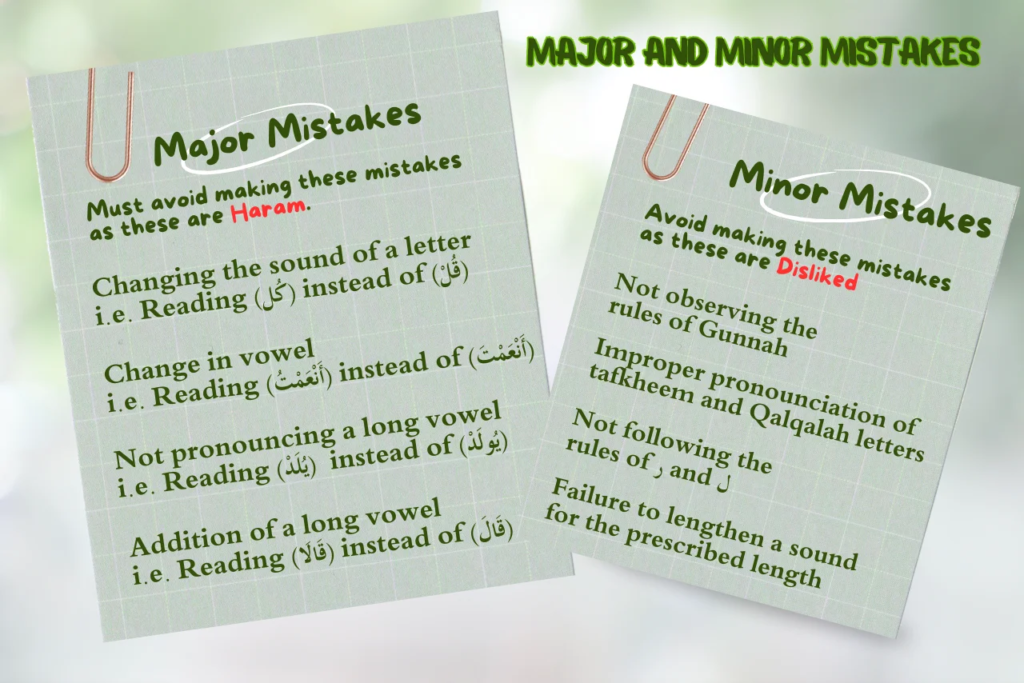
Failing to distinguish between certain letters, such as ‘sīn’ and ‘ṣād’ or ‘qāf and kāf’. For example; Reading Kul (كُل) instead of Qul (قُلْ)
Extending a letter which causes altering the words. For example; Reading Qalaa (قَالَا) instead of Qala (قَالَ)
Eliminating a letter which also causes a change in words. For example; Reading Yulad (يُلَدْ) instead of Yoolad (يُولَدْ)
Replacement of Harakat (vowels) also changes the meaning. For example; Reading An’amtu (أَنْعَمْتُ) instead of An’amta (أَنْعَمْتَ)
Lahn Khafi, The Hidden Mistakes
Lahn Khafi doesn’t touch meaning at all. It touches beauty, how polished and precise the recitation actually sounds.
Shortening a mandatory madd, skipping ghunnah on a stressed mīm, going too heavy or too light on a letter’s natural weight, these are hidden tajweed mistakes that a general audience won’t catch. A trained ear will, though, and that’s really the whole point of studying Tajweed past the basics.
Not All Hidden Mistakes Are Equal
Even within Lahn Khafi, there’s a spectrum. Some slips are mild enough that an attentive general reader might still catch them: a slightly short madd, a rushed pause.
Others sit at the far end, audible only to reciters who’ve spent years training their ear. Stretching a ghunnah too long, or leaning too hard into tafkhīm where it isn’t warranted, falls into that second, more demanding category.
It is the kind of detail that separates good recitation from truly polished recitation.
Lahn Jali Vs. Lahn Khafi: Side By Side
| Aspect | Lahn Jali | Lahn Khafi |
| Noticeable by | Everyone | Trained reciters only |
| Changes meaning? | Yes | No |
| Ruling | Haram by consensus | Disliked; sinful mainly if intentional |
| Breaks prayer? | Yes, if in Al-Fatiha | No |
| Typical cause | Wrong letter, vowel, or word | Weak madd, ghunnah, tafkhīm/tarqīq |
For a learner, recognizing Lahn Jali is often easier due to the noticeable shift in sound. Conversely, Lahn Khafi requires a subtler ear and more advanced skills.
Want to improve your recitation? Don’t miss our guide on 5 common mistakes in Quran recitation, and take the next step in mastering Tajweed!
Does Lahn Break The Prayer? Is It A Sin?
Not automatically, three things have to line up. The mistake has to be Jali, it has to change the meaning, and it has to land in Surah Al-Fatiha. Miss any one of those and the prayer still stands.
Intention matters just as much. Someone who can recite correctly and doesn’t bother is in different territory than a beginner doing their honest best.
The second case isn’t sinful, it’s just a reason to keep learning, not a reason to feel defeated.
How To Actually Get Rid Of Lahn
Listening comes first, before anything else. Sit with reciters who are known for precision, and your ear starts correcting itself before your tongue does.
Real progress, though, comes from structure, learning the articulation points properly instead of guessing at them.
A solid Tajweed course gives you that structure, with a teacher who can catch what you can’t hear in your own recitation.
Pairing that with a grounding in Quranic Arabic also clears up a huge chunk of Lahn Jali, since most vowel-based errors trace straight back to grammar you never quite nailed down.
Understanding meaning helps too, more than people expect. Once you know what a verse is actually saying, the correct word tends to stick, you can dig deeper into that connection in our introduction to Tajweed.
Want personalized feedback on your own recitation? Our tutors help students spot and correct both Lahn Jali and Lahn Khafi through live, one-on-one Tajweed classes.
Keep learning, keep practicing, and remember that every step you take in Tajweed brings you closer to mastering the art of reciting the Quran as it was meant to be recited.
Sign up now and take the first step towards improving your recitation!
FAQs
What’s the main difference between Lahn Jali and Lahn Khafi?
Lahn Jali changes the meaning of a word and is obvious to any listener. Lahn Khafi doesn’t touch meaning, it only affects recitation quality, and only experts tend to notice it.
Is Lahn Khafi a sin?
Scholars are split. Some call it disliked (makruh), others forbidden, but nearly all agree it isn’t sinful for an ordinary Muslim doing their best.
Does every Lahn Jali invalidate prayer?
No. It only invalidates prayer if it’s intentional, changes meaning, and occurs specifically in Surah Al-Fatiha.
Can a beginner avoid Lahn completely?
Not overnight, and that’s fine. Consistent practice under a qualified teacher steadily closes the gap between where you are and correct recitation.