
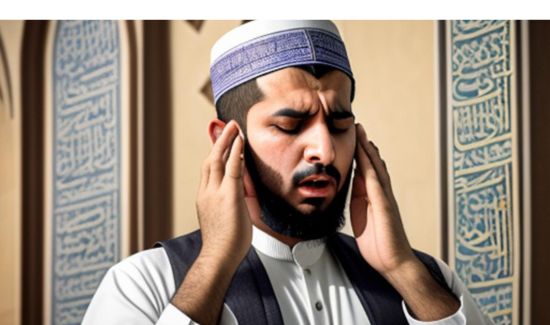
The Call to Prayer in Islam – Adhan History & Significance
The Adhan is the Arabic call announcing each of Islam’s five daily prayers. A muezzin recites a fixed set of phrases- God’s greatness, the twin declarations of faith, an invitation toward prayer- and listeners are meant to stop, listen, and echo the words back under their breath.
Five times a day, every day, for over fourteen centuries.
Where the Adhan Actually Came From
It wasn’t handed down whole. Early Muslims in Medina just showed up for prayer whenever word got around- no bell, no signal, nothing.
The Prophet’s companions floated the idea of a horn (the way Jewish communities called people together) or a wooden gong (as some Eastern Christians did), and neither one stuck.
What finally settled it was a dream. A companion described being taught the words of the call by someone in his sleep, brought it to the Prophet the next morning, and got his approval on the spot.
Bilal and the First Call
Muhammad asked Bilal ibn Rabah, a formerly enslaved man from Africa known for the depth and reach of his voice, to recite it.
That made Bilal the first muezzin in history, and his selection wasn’t incidental- voice quality has mattered in this role from day one.
If you want the fuller narrative of how the early mosque community organized itself around prayer, we’ve covered that in our piece on the foundations of salah in early Islam.
The Words Themselves
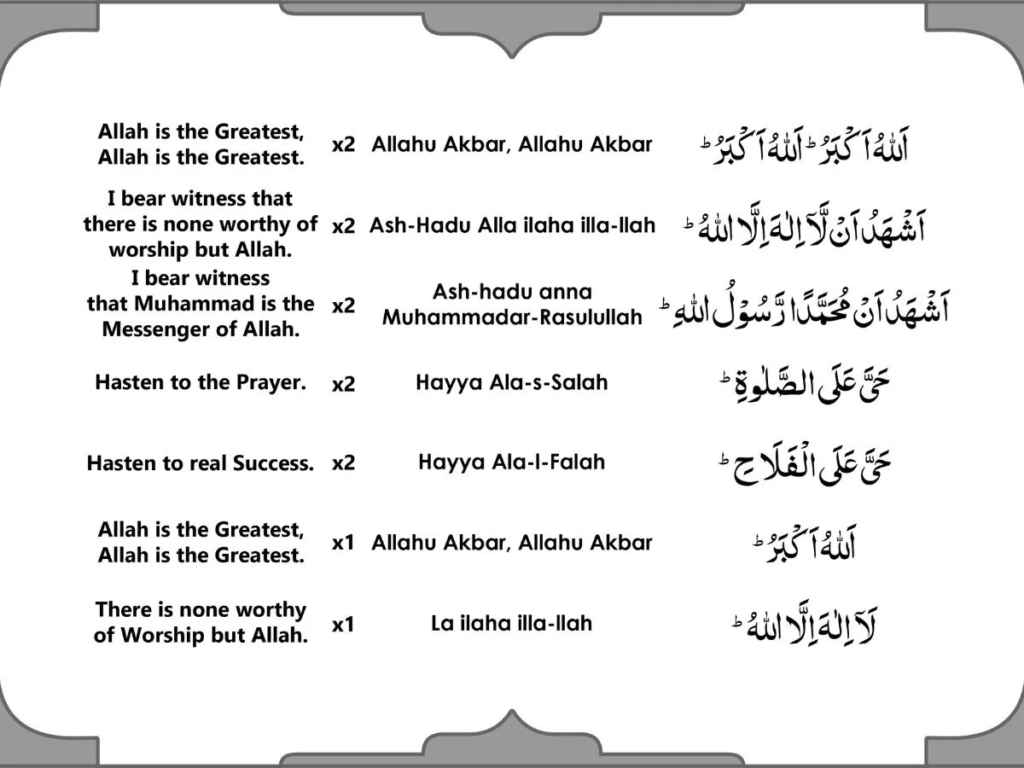
Every line repeats, which is part of the point- it’s not meant to be heard once and processed, it’s meant to land.
The sequence moves from God’s greatness, into the shahadah (there is no god but God, Muhammad is His messenger), and out into an invitation toward prayer and toward falah– a word that means something closer to “ultimate flourishing” than the flat English “success.”
There are small variations between traditions. Some repeat the opening takbir four times, others twice. The Fajr (dawn) call adds one extra line most people have heard even if they don’t know what it means: as-salatu khayrun min an-nawm– prayer is better than sleep, aimed squarely at the moment when staying under the blanket sounds like the better plan.
None of that variation is casual, though. Get the pronunciation wrong and you’re not just mispronouncing Arabic, you’re potentially changing what the words mean.
That is is why so many people who want to recite properly end up going through an actual Tajweed course rather than winging it from a transliteration they found online.
The Core Phrases
| Phrase (transliteration) | Meaning |
| Allahu Akbar | God is greatest |
| Ash-hadu an la ilaha illallah | I testify there is no god but God |
| Ash-hadu anna Muhammadan rasulullah | I testify Muhammad is God’s messenger |
| Hayya ‘ala-s-salah | Come to prayer |
| Hayya ‘ala-l-falah | Come to success |
| As-salatu khayrun minan-nawm | Prayer is better than sleep (Fajr only) |
Listen the Adhan in 8 Maqamat by Shaykh Ibrahim Bakeer
https://www.youtube.com/watch?v=DPHQ-KGnEUg (we have to add this YouTube video here)

Dua After The Adhan
What to say after the adhan, is very important. After hearing the beautiful call to prayer, it is a prophetic, blessed way to recite the dua after adhan.
Not only is this dua a recommended sunnah, but it’s also an excellent way to seek the blessings of Allah and show gratitude for being a Muslim.
This dua is known as the “Dua of Azan,” and it’s a powerful supplication that reminds us of the greatness of our Lord and how fortunate we are to be part of the ummah of Prophet Muhammad (peace be upon him).
So, next time you hear the Adhan, take a moment to recite the Adhan dua and feel the peace and tranquility it brings to your soul.

How It’s Actually Delivered, Depending on Where You Are
There’s a common assumption that it doesn’t “count” unless it’s broadcast to a whole neighborhood. It does.
A muezzin reciting quietly inside a room to a handful of people fulfills the same religious function as the version blasted across a city.
| Setting | What actually happens |
| Majority-Muslim countries | Broadcast over loudspeakers from the minaret, five times a day, whether anyone’s listening or not |
| Mosques in the US, UK, etc. | Usually recited inside for people already there- public broadcast is rarer |
| Community events, rural areas | Called from a rooftop, a sidewalk, sometimes just open land, as a deliberate public gesture |
What the Words Mean, Not Just What They Sound Like
Plenty of people can recite the Adhan from memory without knowing what half of it means- which is fine, but it’s leaving something on the table.
The declaration of God’s oneness at the start isn’t decorative; it’s the entire theological center of the call. The shahadah in the middle is the same two lines a person recites to formally become Muslim. None of it is filler.
This is usually where families decide reciting isn’t enough on its own, and pair it with a proper Quran translation course so the meaning actually sinks in alongside the sound- especially for kids growing up hearing Arabic without necessarily understanding it yet.
How You’re Supposed to Respond to It
The etiquette is more specific than most people realize. You’re meant to stop what you’re doing and repeat the muezzin’s words quietly- with one exception. When he says “hasten to prayer” and “hasten to success,” you don’t repeat those lines. You say something different instead: la hawla wa la quwwata illa billah– there is no power or strength except through God.
After the call ends, there’s a specific supplication asking God to grant the Prophet a station of honor. It’s short, it’s memorable, and it’s usually one of the first things parents fold into a child’s basic Islam course, right alongside the five pillars.
Where the Scholars Actually Disagree
Here’s something that surprises people: not every school of Islamic law agrees on whether saying the Adhan is even mandatory. Hanafi, Shafi’i, and most Shia scholarship treat it as a strongly encouraged sunnah- skip it occasionally and nothing collapses. Hanbali jurists take it further, treating it as a communal obligation for settled men in towns.
They also disagree on when it’s flat-out invalid. Funeral prayers, voluntary prayers, and prayers made up after their proper time has passed get excluded by several schools- though which prayers exactly make that list shifts depending on who you ask.
The Iqamah Is a Different, Quieter Thing
Once the Adhan has done its job of pulling people toward the mosque, a second call happens right before prayer starts: the iqamah. It repeats almost the same wording, with one line added- “prayer is now ready”- and it’s said, not sung out the way the Adhan often is.
The difference in tone makes sense once you think about what each one’s for. The Adhan reaches outward, toward people who aren’t there yet. The iqamah is for the room that’s already full.
FAQs
Does a woman ever give the Adhan?
Several traditions consider it fine- even praiseworthy- for a woman to recite it quietly for an all-female gathering, though it’s not treated as a public call the way a man’s would be.
Can the Adhan be said in a language other than Arabic?
Most jurists say no, at least not for someone who speaks Arabic. A handful of traditions make an exception for people who don’t speak the language at all.
Why does only the dawn prayer get an extra line?
Because it’s the one prayer where the pull to stay in bed is strongest- the line exists specifically to counter that.


